Sunday, September 29, 2013

Bookviews - October 2013

By Alan Caruba

My Picks of the Month

For policy wonks like myself, a number of new books will provide a variety of insights. In 2012, the  U.S. Supreme Court became the center of the political world when, in a decision that astonished constitutional scholars or ordinary citizens, it voted 5-to-4 to save the Affordable Care Act, commonly called Obamacare. The story of how the case reached the Court is told by Josh Blackman in Unprecedented: The Constitutional Challenge to Obamacare ($27.99, Public Affairs) and, given its impact, affecting individuals, physicians, the increase in the size of the government to administer and enforce it, and the economy, it will be one of those decisions that has far-reaching effects on life in America. The fight to overturn Obamacare became a legal firestorm, but the best way to understand it was the broadening of the already-stretched-to-the-limits Commerce Clause. The ruling said in effect that the government had the right to require people to purchase health insurance even if they did not want to and the right to fine them if they did not. This is unprecedented. Ultimately, the Chief Justice cast the deciding vote on the grounds that Obamacare was a tax and the constitution assigns that right to the government. The law goes into full effect this month and has already been unilaterally altered by the Obama administration and is replete with waivers for various favored constituencies.

In the Balance: Law and Politics in the Roberts Court by Mark Tushnet ($28.95, W.W. Norton) will likely appeal to lawyers and those with an interest in the way shapes public policy. Most certainly, Chief Justice Roberts’ vote that permitted Obamacare—the Affordable Care Act—to proceed on the basis of its being a tax will be of greatest interest to readers. The author is a professor at the Harvard Law School and a prominent scholar on constitutional law, so those concerned about the role the Court plays will find much of interest as he and others try to determine the outcome of future votes and the thinking behind previous ones. He reviews cases involving First Amendment, gun control, abortion rights, business regulations and other issues, concluding that law and politics exist side by side on the Court.

Two new books take a look back over the politics and issues that have shaped and changed life in America since the 1960s. Front Porch Politics: The Forgotten Heyday of American Activism in the 1970s and 1980s by Michael Stewart Foley ($30.00, Hill and Wang) recounts the history of campaigns both famous and forgotten, from the steelworker’s fights against factory shut-downs to farmer’s struggles to save their farms and communities, along with other examples of community activists and neighborhood groups demanding toxic waste clean-ups. The better known battles of the time included gay rights, and helping the homeless. He concludes that Americans were more inclined to get directly involved in issues that affected them while today they seem to have lost their belief in direct political action. All in the Family: The Realignment of American Democracy Since the 1960s by Robert O. Self ($17.00, Hill and Wang) examines the way the changes affecting marriage and the nuclear family affected the politics of the last five decades as more single-parent families occurred, as programs such as Lyndon Johnson’s War on Poverty actually worsened the situation, particularly for African Americans, than anticipated, and as issues such as same-sex marriage emerged. The changing role of the white heterosexual male as the breadwinner was significantly changed and the issues of “traditional values” regarding the family came under attack. It is a very different society from that which existed following the end of World War Two and this book explains the how and why of that change.

A massive campaign to demonize people who enjoy lighting up a cigarette, a cigar or a pipe has led to bans on smoking just about everywhere, including in some places, in one’s own home if children live there. Michael McFadden has written “TobakkoNacht: The Antismoking Endgame.” (Aethna Press, $27.95, softcover) The title is a play on Kristallnach, a 1938 event in Nazi Germany that revealed the depths of that regime’s hatred of Jews, leading eventually to the Holocaust. Smokers are not being rounded up and killed, but they are subjected to bans and meritless increases in the cost of smoking; taxes that greatly benefit the states imposing them while using the power of taxation to denigrate smokers. McFadden’s research is extensive and in depth when it comes to exposing the many myths about smoking and his expert knowledge of statistics debunks how they are cited to further efforts directed against smokers. To learn about the scope of the effort to ban smoking, this book will provide the answers and I highly recommend it.

A few miles from where I live is West Orange where Thomas Edison lived and had his laboratories after his early years in Menlo Park. We now take for granted those early and many inventions, the incandescent light bulb, movies, phonograph machines, even Portland cement.. Edison was the first business celebrity, along with Ford and Firestone, and it is fitting that another innovator, Bill Gates, would have written the foreword to Edison and the Rise of Innovation ($29.95, Sterling Publishing). It is a really wonderful book about the prolific inventor and the way he combined scientific knowledge, well-equipped laboratories, talented collaborators, investment capital, and a real talent for showmanship in ways that transformed how new technologies were funded and created as the last century dawned. Leonard DeGraaf, the archivist for the Thomas Edison National Historical Park, was the ideal man to write this book that, in a large format, is filled with Edison’s examples of his personal and business correspondence, lab notebooks, drawings, all lavishly illustrated to bring his life, his success and his era to life in a way that anyone who loves history will thoroughly enjoy. Thinking ahead to Christmas, this book would make a great gift for anyone with an interest in history, technology, and innovation.

There is endless discussion and debate about the educational system in America and everyone agrees that kids in the inner cities are often cheated of the benefits of those in wealthier suburban area. Ilana Garon has done them a big favor with “Why Do Only White People Get Abducted by Aliens?: Teaching Lessons from the Bronx ($24.95, Skyhorse Publishing) as she tosses out political correctness and the popular image of the “teacher-hero” and reveals the true stories, sometimes hilarious, often shocking, that she encountered as a new teacher navigating the public school system. From gang violence to teen pregnancy, to classrooms infested with mice, Garon say it all. In the process, her wily students made her realize how little she knew about teaching, about poverty, and about life in urban America. In the process she provides the reader with some real insight to what is occurring (or not) in classrooms where securing an education must cope with many other challenges.

The Topic is Health

One need only listen to radio or watch television to realize how health-conscious Americans are. They are obsessed with the topic. It is no surprise, therefore that there are also a regular flow of books on various health-related topics. Here are some of the latest.

Every parent wants their baby to grow up healthy and happy. Ruth Yaron has updated and revised Super Baby Food ($19.99, F.J. Roberts Publishing, softcover) topping out at just over 650 pages! When her twin boys were born prematurely and very sick, she applied herself to learning everything about how to prepare natural, healthy foods for them. While she knew how to program satellites for NASA, she was an inexperienced cook, but she put her research and mathematical skills to work as she studied all aspects of homemade, mostly organic, whole grain cereals, fruits, and home-cooked vegetables, along with the best storing and freezing methods. Within this remarkable compendium of information on the subject is a whole world of healthy foods for newborns and infants. 

Making Peace with Your Plate: Eating Disorder Recovery by Robyn Cruse and Espra Andrus, LCSW ($16.95, Central Recovery Press, softcover) addresses anorexia, an eating disorder that has the highest mortality rate of any mental illness. Then there is binge eating and bulimia as well that can bring misery and death. Ms. Andrus is a clinical therapist who specializes in working with people suffering a range of eating disorders. Ms. Cruze recovered from an eating disorder that had crippled her spirit for more than a decade. She is a freelance writer and, together, they have produced a book that will be of enormous help to anyone struggling to overcome an eating disorder with its unique three-phase approach to eating that provides a concrete plan for long-term recovery. If this describes someone you know, I would recommend you give them this book. Also from the same publisher is Love in the Land of Dementia: Finding Hope in the Caregiver’s Journey by Deborah Shouse ($15.95, CRP, softcover. This book provides compelling evidence that love is the greatest healing force on earth and the author tells of how Alzheimer’s disease began to claim her mother, it threatened the fabric of her parent’s long and loving marriage, and strained relationships with family and friends. However, over time when even memory and identity were all but gone, they found ways to make their peace with her disease. For anyone facing a comparable experience, this book will be a blessing. Both of these books has an official publication date in November.

A problem that is all too common is establishing and maintaining relationships and, in Forging Healthy Connections: How Relationships Fight Illness, Aging and Depression ($14.95, New Horizon Press, softcover) Trevor Crow and Maryann Karinch join forces to explore strategies that anyone can implement in order to create and maintain a healthy network of connections that provide an emotional safe haven in our professional and personal lives. They examine why so many of us fail or lose relationships as we age, explore trust issues, and other causes of a loss that has a direct effect on our health and mental well-being. Ms. Crow is a licensed marriage and family therapist and Ms. Karinch is the author of 18 books, many of which focus on human behavior. Together they make a great team and this book can help anyone, older readers and those who will be older, resolve some of the problems they may be encountering. A useful book is 9 Realities of Caring for an Elderly Parent: A Love Story of a Different Kind by Stefania Shaffer (19.95, Pressman Books, softcover) is written for the 43.5 million American adults who provide care for someone—their spouses, friends, and most of all, their parents. This guidebook will provide a treasure of useful advice, but perhaps the most important is for the caregiver to attend to their own health because it does take a toll if you do not. And it can be costly, too. If you are a caregiver or know one, this book is filled with the kind of information and advice that is invaluable.

Healing Pain and Injury by Maud Nerman ($24.95, Bay Tree Publishing, softcover), an assistant professor at the Western University College of Osteopathic Medicine and an adjunct clinical professor at Tuoro University Medical Center, brings over thirty years of experience to the subject of recovery from all manner of neurological problems from brain injury to epilepsy.  The book’s focus is treating pain and injury resulting from trauma. The author offers three simple steps to understanding and treating the hidden and little recognized causes of traumatic pain. If you continue to experience pain despite treatment, this book may unlock the doors to relief.

Biographies, Autobiographies & Memoirs

You could fill a library with books about Franklin Delano Roosevelt, the only man to win four elections to the presidency, a man who led the nation through World War II, and a master politician. It is the younger Roosevelt who is often overlooked and Stanley Weintraub fills that gap with Young Mr. Roosevelt: FDR’s Introduction to War, Politics, and Life ($25.99, Da Capo Press).   Anyone interested in American history and, in particular, the portion that FDR dominated, will welcome the way FDR’s formative years prepared him. Remembered for his successes, his early life taught him how to deal with failure and, of course, the Polio that left him crippled. During his presidency, few Americans ever saw a photo of him in a wheelchair. To stand, he required heavy metal braces. By the spring of 1913, however, he began his political career with an appointment as the assistant secretary of the Navy. That would be followed by a failed initial run for vice president, and, as noted, Polio. What the noted historian demonstrates is that Roosevelt not only learned from those trying times, but grew past them. It is a remarkable journey.


I often wonder what kind of courage it must take to be a war correspondent and, to a great extent, Paul Conroy’s new book, Under the Wire: Marie Colvin’s Last Assignment, ($26.00, Weinstein Books) provides the answer. Ms. Colvin wanted to be where the war zone was, wanted to report on what was occurring, and she paid for that with her life in Syria in 2012 after both had been smuggled in by rebel forces. She died during a hellish artillery attack that also seriously wounded Conroy who was a former British soldier with fifteen years covering conflicts in Iraq, Congo, Kosovo, and Libya, prior to Syria. Both shared a compulsion to bear witness to events. Anyone who has spent any time in a war zone, in combat, or just wondering what it is like will thoroughly enjoy this book. One might say they shared a foxhole or two together and the story he tells is gripping and a great tribute to his friend, a great journalist. Wars, of course, generate all manner of books and World War II is still a rich source.
 
Military historian and retired U.S. Marine, Dick Camp, the author of a slew of books, has written Shadow Warriors: The Untold Stories of American Special Operations During WWII ($30.00, Zenith Press) which, despite the nearly seven decades that have passed, still have the capacity to amaze. It is the story of the top-secret exploits of the brilliant, courageous, and previously unacknowledged heroes. Only in recent years have their exploits been declassified and Camp provides an action-packed narrative of units that composed the special forces, laying the groundwork for many of our present-day units such as the SEALS and others. Camp’s book addresses both the European and Pacific theaters which required elaborate spy networks, covert parachutists, amphibious raids, and, yes, even the occasional catastrophic mission failure.


Joseph Wheelan goes further back in our history with Terrible Swift Sword: The Life of General Philip H. Sheridan ($16.99, Da Capo Press, softcover), one of the great generals of the Civil War, part of a triumvirate that included Ulysses S. Grant and William T. Sherman. He was the youngest of the three, but his fame came not only in winning battles, but for his skills as a strategist and his personal leadership in battle. It was Sheridan who applied the concept of “total war”, a scorched-earth approach that is credited with winning the war and one he had ruthlessly used in campaigns against the Plains Indians to bring them to reservations. Once there, he became one of their most high-profile protectors. This is a first-rate biography that would be enjoyed even by a son of the old confederacy for its attention to detail and portrait of a man of courage and honor.

The Italian courtier, author of “The Prince”, Niccolo Machiavelli, has had his last name immortalized as a synonym for the options and methods a ruler has in order to stay in power. As Joseph Merkulin, the author of Machiavelli: A Renaissance Life ($21.95, Prometheus Books, softcover) reveals,the often vilified Machiavelli as both a diabolically clever, yet mild-mannered and conscientious civil servant. In 720 pages, his life was a true adventure, filled with violence, treachery, heroism, betrayal, sex, bad popes, noble outlaws, menacing Turks, and a cast of others who peopled an era famed for the power of the Medici family and shared with both Leonardo da Vinci and Michelangelo. At one point he as imprisoned, tortured, and ultimately abandoned, but he remained the sworn enemy of tyranny and, to the surprise of many who will read this book, a champion of freedom and the republican form of government! Anyone who loves biography and history will most surely enjoy this book. Another man immersed in the politics of his era is the subject of Upton Sinclair: California Socialist, Celebrity Intellectual ($28.95, University of Nebraska Press). Lauren Coodley provides an opportunity to learn about a man famed in his time as the author of “The Jungle”, and an inveterate embracer of all manner of causes. He has largely vanished in terms of any legacy despite the fact that he wrote nearly eighty books and even won a Pulitzer Prize for fiction. In the first half of the last century, his writing and activism made him a household name who dedicated himself to helping people understand how society was run, by whom, and for whom. It was a time when socialism was on the rise in America and much of its agenda has been written into an entitlement society that exists today. His interest and support of feminism and a devotion to healthy living put him ahead of his time. He’s worth getting to know.

God’s Double Agent by Bob Fu with Nancy French ($19.95, Baker Books) may surprise you with the fact that tens of thousands of Christians live in China today, living double lives to avoid a government that relentlessly persecutes them. By day, Bob Fu was a teacher in a communist school and by night he was a preacher in an underground house church network. He tells of his conversion to Christianity, his arrest and imprisonment for starting an illegal house church, his harrowing escape along with his wife in 1997, and his life since in the United States as an advocate for those who want to enjoy the freedom to worship as they wish. This book is worth reading not just for the inspiring story of his life, but to remind ourselves of freedoms we take for granted. Richard Rodriguez has authored Darling: A Spiritual Autobiography ($26.95, Viking) and the title refers to a friend who has since passed away who he met on the day her divorce was finalized. “As a homosexual man, at a time of growing public acceptance of homosexuality,” says Rodriguez, “I find myself thinking about my intimacy with heterosexual women, and my debt to them for my formation as regards both my spirituality and my sexuality.” His book is a Roman Catholic’s personal exploration of, not only Christian history, but of Judaism and Islam, and the roles each played that have brought them to the present times. There may not be a large audience for this book, but those that read it will find it challenging and entertaining at the same time.

A very different kind of autobiography is found in Heist and High by Anthony Curcio and Dane Batty ($15.95, Nish Publishing Company, Portland, OR, softcover). Curcio was an all-American high school football star, a kid with a short at being an all-star college wide receiver, and maybe even going onto the NFL, but an addiction to a prescription pain-killer drug led him to pull off a robbery of a Brink’s armored truck that netted him more than $400,000. He headed for Las Vegas where he was subsequently caught. It was a sensational crime at the time and the detective who caught him said the robbery had “all the preparation of a top-notch heist by an experienced criminal.” This is a cautionary tale because it is estimated that more than eleven million people abuse these drugs. Curcio is rebuilding his life after serving his federal prison sentence in Texas and Florida, having been released in April of this year. His co-author has assisted in telling a fast-paced, very moving story.

Books for Younger Readers

A very cute book, Summer Saltz: I’m So Hollywood, by Connie Sewell and illustrated by Elyse Wittaker-Peak ($16.95, Tiny Hands Publishing, Hilton Head, SC) has a lesson for young readers, ages 3 to 8, about just being oneself and not taking on airs. When fun-loving Summer gets a pair of an ever-so-sassy pair of white sunglasses, she takes on the personality of “I’m so Hollywood” and plans a party to show off a bit. When her best friend shows up wearing the same glasses and the fun begins as she learns that it is not what one wears, nor adopting the attitudes of movie stars. Young readers (and those being read to) will learn a valuable lesson along with Summer and thoroughly enjoy it. For those youngsters who love wordplay there’s Sir Silly: The World Where Words Play by David Dayan Fisher ($6.95, Sunnyfields Publishing) where Sir Silly thinks in rhyme and lets his imagine dance freely. Illustrations by Patricia Krebs enhance the text and the book is sure to impart some lessons in the way language, plus imagination, can open the mind to useful lessons in the way the world works.

Mermaid Sails the Bay marks the debut of Greg Trybull ($16.66, Amazon.com, softcover) will particularly please young adults. It is springtime in 1908 in a San Francisco still recovering from the Great Quake of 1906. It is a time of advances that include electricity, automobiles, and radio, but is also a time when the era of the great sailing ships will give way to more modern vessels. Three brothers, Ed (16), Bill (14) and Ted (12) are about to embark on an adventure when their father buys them a 16-foot Whitehall boat which they christen the Mermaid. That summer they encounter Teddy Roosevelt’s Great White Fleet and end up the target of pirates that shoot rotten fruit for cannonballs. They surmount the rough seas, save the lives of new friends, and learn to get along with one another. This is a great way to enjoy history and indulge young dreams of adventure. Another kind of adventure is found in Mickey Price: Journey to Oblivion by John P. Stanley ($15.99, Tanglewood) a science fiction romp that even NASA astronaut, Buzz Aldrin, liked. He said, “This rocket-speed adventure captures all the danger, mystery, and excitement of NASA moon missions with laugh-out-loud moments along the way. It also reminds us that there are still great mysteries on the moon and beyond, just waiting to be discovered and explored. I know kids will love this story and I hope it inspires them. Go outside at night—look at the moon—dream big!”  Written for those ages 8 to 12, even a slightly older reader like myself, like Aldrin, thought this book was terrific.

Another novel that will appeal to younger readers, as well as older ones, is Fifteen Minutes by Karen Kingbury ($22.99, Howard Books, an imprint of Simon and Schuster) that examines the price of fame as it raises questions about compromise, character, and cost in a celebrity-focused culture. Kingsbury has been called “the queen of Christian fiction” and draws on her friends among the music industry elite where she lives in Nashville. When the former winner of a TV talent show takes her turn as a judge, she has a secret motive to save others from the perils of fame. The focus of her concern becomes Zack Dylan, the most popular contestant, who has kept his strong faith as well as a girlfriend back home secret. Will the glare of fame cause him to lose everything he holds most dear? It is a question worth asking and answering. Teens will likely enjoy Crypto-Punk self-published by George Traikovich ($9.00, Kindle 99 cents, Amazon, softcover) about the latest fad at Bixby Elementary, dressing like B-movie monsters. What is driving the strange compulsion? That is what the Zero Avenue kids, Drew, Clementine, Grady, Newton, and Spider, as they unravel the threads of a conspiracy that blurs the line between science and magic, friends and enemies, and which draws them into an adventure that tests their character and their loyalties to one another. This one is scary and lots of fun.

Novels, Novels, Novels

I say it every month, but it is no less true that there is a torrent of novels being published, either by mainstream publishing houses or, increasingly, self-published. No need complain for a lack of fiction these days. My fiction team is recommending a bunch this month.

One new novel feels like it comes right out of the daily headlines even though it is set ten years into the future. Jack Belmonte makes his debut with The Octavian Latticework ($22.00, Voltaire Publishing) in which a rookie counter-terrorism agent for the fictional U.S. Anti-Subversion Authority is hot on the heels of Brigade 910, a domestic terror group that is led by the shadowy Octavian. Johnny Luca and his partner discover plans for a major attack. In the White House, President Reed Wilkins has vowed to veto a draconian Total Information Awareness Act that would turn the U.S. into a total surveillance state. It’s up to Luca to save the president from assassination and to thwart the plots. Well, suffice to say, it is a story filled with political secrets, government cover-ups, and domestic terror plots. Another novel, The North Building ($15.50, Munroe Hill Press, softcover) takes one back to the days of the Cold War. Jefferson Flanders, the author, obviously finds this an interesting period of history as he set a previous novel in it as well. This is a sequel to “Herald Square.” Whether you know anything about the Cold War or not, you too will find it of interest as Flanders takes us back to the years just after World War II when the Soviet Union became the greatest challenge to the U.S. and Europe, a threatening presence in the world. Set in New York in 1951, Dennis Collins is returning from covering the war in Korea. The last thing he wants is to be sucked into a world of spies, counterspies, and the leaked military secrets that may have contributed to the retreat to the Chosin Reservoir, a low point in the conflict. The novel has some familiar names from that era that include President Eisenhower, Allen Dulles of the CIA, and the British spy ring led by Philby and MacLean. The North Building of the title is the office on the CIA campus where agents out of favor with their higher-ups get exiled to ponder their errors. This is a taunt and heart-racing geopolitical thriller that includes a nicely interwoven romance as well. A Washington Times reviewer loved it; I did too, and so will you.

Another excellent novel. Rising Sun, Falling Shadow by Daniel Kalla ($27.99, Tor/Forge) occurs in 1943, during the Japanese occupation of Shanghai, China, trapping droves of American and British citizens, along with thousands of “stateless” German Jewish refugees,  behind enemy lines.  Despite the hostile environment, newlyweds Dr. Franz Adler and his wife, Sunny, adjust to life running Shanghai’s only hospital for the refugee Jews. Bowing to Nazi pressure, the Japanese force their Allied friends into internment camps and relocate the twenty thousand Jews into a one-square-kilometer “Shanghai Ghetto.”  Heat, hunger, and tropical diseases are constant threats, but the ghetto demonstrates miraculous resistance, offering music, theatre, sports and Jewish culture despite the condition. This is a tale of espionage, survival, and the power of love and family. World War II generated another novel, Brave Hearts by Carolyn Hart ($13.95, Seventh Street Books, softcover) as it tells the story of Catherine Cavanaugh, caught in a loveless marriage with a British diplomat. It is wartime London and the Germans are bombing London. She meets an American war correspondent, Jack Maguire, and rediscovers hope and love again, but the war intervenes when she and her husband are unexpectedly transferred to the Philippines. Jack follows, but shortly after their arrival the Japanese attack and trapped civilians are forced into a harrowing adventure to escape them. Hart is a cofounder of Sisters in Crime and won many awards for her novels—more than fifty—so you know she knows how to tell a gripping story.

Murder has long been a staple of fiction and Jonas Winner gives it a new twist in The Beginning: Berlin Gothic ($14.95, Thomas & Mercer, softcover). Long after the Iron Curtain has come down, Till Anschutz has been taken in by the Bentheims and, along with his new brother, 12-year-old Max, the boys explore the office where their cold, distant father, horror novelist, Xavier Betheim, writes his novels. They discover a secret door that leads to a dark hallway that connects to the city’s underground tunnels. They also discover gruesome photographs and films, leading them to conclude that Xavier has been leading a disturbing double life. Meanwhile, Berlin Police Inspector Konstantin Butz is working on the case of a mutilated corpse of a woman. It is the latest in a series of related murders. This novel is full of twists and turns that will keep you turning the pages. Another novelist, James Sheehan, knows a lot about the law. He practiced it for thirty years and has written three acclaimed legal thrillers. His latest is The Alligator Man ($23.00, Center Street, Hachette imprint).  Someone has killed Roy Johnson, the former CEO of Dynatron, famous for preying on smaller companies, stripping them of their assets and leaving their employee out in the cold. Lots of people have a motive for killing him. Pieces of his clothing have been found in alligator-infested waters. The assumption is murder and one of those on whom suspicion falls is Billy Fuller who lost everything, but is now a New York Times columnist. A former childhood friend, Kevin Wylie, a Miami attorney, learns of Billy’s problem and, though all the evidence points to his guilt, he believes Billy is innocent. I recommended Sheehan’s last novel, “A Lawyer’s Lawyer”, and I definitely recommend his new one.

The Last Animal by Abby Geni ($24.00, Counterpoint Press) is a treat for anyone who loves reading short stories. Geni is a graduate of the prestigious Iowa Writer’s Workshop and someone who observers expect to become a major name. She is off to a great start with this collection, ten remarkable stories unified around the theme of people who use the interface between humans and the natural world to cope with issues of love, loss, and family life. The stories are thoroughly researched, giving them an authenticity. This collection has already garnered many accolades and I will add my own to them.

That’s it for October! Come back next month and don’t forget to tell your friends, family and co-workers who love a good book about Bookviews.com.

Friday, August 30, 2013

Bookviews - September 2013

By Alan Caruba

My Picks of the Month

 
The one book you must read this month is Erick Stakelbeck’s The Breakthrough: America’s Next Great Enemy ($27.95, Regnery Publishing Co.) because it will tell you what you need to know about the September 11th “Million Muslim March” in Washington, D.C. and why the Muslim Brotherhood haa been in the streets of Cairo trying to retake control of Egypt after having been banned for more than five decades there until the overthrow of the Mubarak regime. Secular Egyptians are fighting to avoid having to live under Sharia law, the 1,400 year old system of slavery that sanctions beheadings, stoning, and the oppression of women and all other religions. You will learn about its history and how widespread it is in America, using a variety of front groups, all devoted to destroying our nation along with, of course, Israel. Founded in 1928 by fanatical Muslims, it is in eighty nations and boasts over a hundred million followers. You will learn how the White House has opened its doors to some of its leaders, how top ranked national security officials favor Islam, and how mosques are being built throughout the nation in order to proselytize and create enclaves in our midst from which will come those who will use terrorism against us. Americans are being deceived by our own media, by those in our universities, and by those in our government. This book spells it out, documenting what has occurred and what will occur if Americans do not waken to this threat to the nation and the West.


The reelection of Barack Obama was a tremendous shock to Republicanswho could not conceive that a first term that began with enormous spending—the stimulus—that produced no shovel-ready or other permanent jobs or any improvement to the economy and ended with the Benghazi scandal in which a U.S. ambassador and three others will killed in a terrorist attack would not hand the election to Mitt Romney, their candidate. What Went Wrong: The Inside Story of the GOP debacle of 2012 and How it can be Avoided Next Time by Jerome R. Corsi, Ph.D. ($25.95, WND Books) is a brilliant analysis of why the GOP again choose a “me too” candidate and, in Romney’s case, a man who utterly failed to wage an aggressive campaign. Corsi explains how the Democratic campaign relied on the most modern techniques of computer modeling to identify exactly who to reach, combined with a get-out-the-vote campaign that ensured that more of them actually voted. The GOP thought that Romney’s economic message of small government, lower taxes, and less regulation would resonate with voters, but it did not and, in the end, a significant number white Republicans, the party’s core, just stayed home, disappointed with the campaign. It cost them the White House, but Tea Party candidates, scorned by the GOP elites did well at the polls. Obama was reelected by his core constituency, African Americans who voted 98% for him, Hispanics, single women and younger voters. Republicans, Tea Party supporters, conservatives and independents should read this excellent book to learn what must be done in the forthcoming 2014 midterm elections and how to capture the White House and Congress in 2016. Corsi believes it can be done.
 

Having begun my professional life as a very young journalist in the late 1960s, I found Harry Rosenfeld’s memoir, From Kristallnacht to Watergate: Memoirs of a Newspaperman ($29.95, Suny University of New York Press) of interest as he recalled his family’s escape from Nazi Germany to the U.S., his youth growing up in New York, and his love of journalism that began early with a low-level job with the Tribune. Rosenfeld made his way up to editorial positions with the Washington Post and played a pivotal role when the Watergate scandal began as a break-in of the Democratic headquarters. He recounts how Bob Woodward and Carl Bernstein, both young reporters, were selected to investigate and how it grew into the greatest scandal to affect a U.S. president ever. It would take two years before Nixon resigned in the face of a pending impeachment. It is history as seen through the eyes of a journalist that is a contribution to understanding much about newspapers in an era where they were the dominant provider of news to the present times. It is a personal story, but it is also a story of the most dramatic times America passed through since the end of WWII.


A new breed of journalist has emerged in the digital age and Breakthrough: Our Guerrilla War to Expose Fraud and Save Democracy by James O’Keefe ($26.00, Threshold Editions, an imprint of Simon and Schuster) is the extraordinary story of how this young man and colleagues exposed the corruption of ACORN, leading to Congress defunding the voter fraud organization, revealing the biases within National Public Radio, the easy tolerance of fraud at Planned Parenthood, and in many government agencies. In 2010 O’Keefe formed Project Veritas, a 501c(3) organization dedicated to citizen journalism. Best known for its sting operations that caught the various operatives of these organization on camera, O’Keefe is dedicated to exposing corruption that endangers the election process, the contempt of organizations that receive government funding, and many other ills within our society and government that undermine our values. He was fortunate to find a mentor in the late Andrew Breitbart, but the untold story until now is the way the Left fought back with law suits and outright lies intended to defame him and his group. What he accomplished was funded largely on his credit cards in the early years and his dedication got him through some very scary moments. If you have a feeling that something is very wrong with our nation’s institutions, you will find your fears confirmed in this excellent book that exudes his still youthful enthusiasm for “citizen journalism.”  
 
Jay W. Richards undertakes to explain the elements that led to the 2008 financial crisis in Infiltrated ($25.00, McGraw Hill Education). He is a philosopher with a special focus on politics and economics. The book is described as “part socioeconomic analysis and part examination of the continuing debate over who is to blame for the crisis and who is still trying to gain from it.” I found it tough going to the point where I finally gave up. About the only thing I know is that we live in an era of crony capitalism and the interplay between government and the financial markets is intricate and deep. Suffice to say, only those with a concerted interest in such questions will want to read this book and, I suspect, there are so many players involved that it defies much more than informed speculation.

 
Am I a Jew? By Theodore Ross ($16.00, Plume, softcover) will intrigue both Jews and Christians as the author tells the story of how, when he was nine years old, his mother forced him to convert to Christianity after growing up in a Jewish family. When she moved to a small town in Mississippi, she wanted to pass and, one assumes, wanted to make life easier for Ross, but he always knew he was a Jew and those years never really altered that perception. His parents were divorced so he was a Christian in Mississippi and a Jew in Manhattan when he returned to visit his father for holidays and summer break. As an adult living in New Mexico he became aware of “crypto-Jews” of Spanish origin, those who fled the inquisition or pretended to convert to avoid death. As he began to pursue this slice of history he became aware of how many people believed they were Jewish though living gentile lives. A whole sub-culture of those seeking to “return” to their spiritual roots was revealed to him. Told with humor and a sharp eye for detail, Ross tells his own story and that of others seeking an answer.  Linked only by Judaism, Bombed in His Bed: The Confessions of Jewish Gangster Myer Rush ($16.95, Alma Rose Publishing, softcover) is an as-told-to book by Bruce Farrell Rosen, his nephew. Rush was a very successful gangster who grew up in Depression-era Toronto, a man who would have been successful in any enterprise, accumulating wealth through crime and legitimate enterprise. He had a gift for stealth, and chutzpah, but he disdained the press and the way he was depicted. He was, as the saying goes, larger than life. He was in turn a cat burglar, ran guns into Palestine before it became Israel at the request of a rabbi, marketed a sex herb he discovered, and bought companies, turning them and other ventures into success stories. There is no way to briefly describe his life and we can thank his nephew for getting him to share his life for what is a very interesting biography.

 
Every so often a book comes along that I know will appeal to a narrow niche of readers and, in the case of Land of Lincoln—Thy Wondrous Story: Through the Eyes of the Illinois State Society ($40.00, Jameson Books, Ottawa, IL) by Mark Q. Rhoads that is surely the case. It helps if you were born, bred and perhaps still live in Illinois. The author was the president of the Illinois State Society from 1989 to 1990, serving on its board for 27 years until 2012. Suffice to say he has had a long and distinguished career, all of which touches upon his beloved state in some fashion or other. His book is a definitive history of Illinois reaching back to 1853 and moving along to the present through the events and the lives of men who made their mark on the nation and the state. We all know about Lincoln, but the book is filled with the politics of Illinois that was filled with interesting people, some on the national stage, others in the state, some of whom helped share the history of the nation as well.
 
Visible Ink Press publishes a series of books that I recommend highly. They come under the common title of “The Handy” book of “Answers” and several are debuting this month. They include The Handy Chemistry Answer Book, The Handy Astronomy Book (Third Edition), and The Handy Art History Answer Book, all priced at $21.95 and all authored by experts in their fields. Earlier editions in my personal library include answer books about history and science. In a very complex world, these books are a treasure of information that break down their topics into easily comprehended and informative texts that provide hours of interesting and entertaining reading while turning you into the smartest person in the room!  To learn more about this series, visit www.handyanswers.com.

 
Silly, Funny, and Fun


Some books are just supposed to be fun to read and that surely applies to Ripley’s Believe It or Not ® Dare to Look!, a coffee table, large format book ($28.95, Ripley Publishing) that is filled with some of the most bizarre, incredible, and amazing true stories from around the world. Moreover, by downloading an APP for “oddScan” you can scan some of the images and they come alive off the page. This book will appeal to anyone with an interest in the odd ways some people behave and the things they do. There’s the guy who pinned 161 clothes pegs to his face, an eight page gatefold of ventriloquist’s dummies, and much more fun stuff on every page.
For those who enjoy exploring mysteries, conspiracies, and cover-ups, Nick Redfern’s Monster Files ($15.99, New Page Books, a division of Career Press, softcover) will more than satisfy with its “look inside government secrets and classified documents on bizarre creations and extraordinary animals.” Redfern has either uncovered some strange information from “secret files in the Pentagon, the Kremlin, the British military, and other government agencies” or he is putting on the reader. Either way, it is quite entertaining with its tales of lake monsters, an alleged link between the CIA and the Abominable snowman, and Russian experiments with animal ESP.

 
There is one type of book that I enjoy simply because it is so much fun. It is a collection of odd facts and 1,227 Quite Interesting Facts to Blow Your Socks Off by John Lloyd, John Mitchinson, James Harkin and the QI Elves ($15.95, W.W. Norton) lives up to its title. Lloyd and Mitchinson are the creators of an award-winning BBC quiz show called “QI” and Harkin is a senior researcher. It is pure trivia, but it is arranged so that each page’s items link together in some fashion. Not that it matters because each page has some surprising fact such as the international dialing code for Russia is 007 or that heroin was originally sold as a cough medicine. Did you know that Google makes more money--$20 billion a year—from advertising than CBS, NBC, ABC, and FOX combined? You will liven up your conversations with all manner of facts after you’ve read this very entertaining book.
 
By far the most amusing take on ghosts I have seen in a very long time is Doogie Horner’s 100 Ghosts: A Gallery of Harmless Haunts ($9.95, Quirk Books)  just in time for Halloween next month. In fact it would make a great Halloween gift. Horner is a writer, designer, and stand-up comedian with two previous books to his credit. Suffice to say he has a very whimsical mind and the illustrations that compose the book show many variations on the theme of the white sheet and two eye-holes that is the comic book version of a ghost. He has found some very amusing ways of taking this simple piece of artwork and transforming it into a chuckle on every page of a book you can hold in the palm of your hand.

 
Lots of Useful Advice
 
I think someone has been writing a book of advice since the invention of the printing press and, of course, the Bible, written much earlier, is filled with advice on how to live one’s life. A number of such books have arrived so let’s take a look at them.
 
Raising a young man to turn out well is always a parent’s concern and Rick Johnson offers some advice in A Man in the Making: Strategies to Help Your Son Succeed in Life ($12.99, Revell, a division of Baker Publishing, softcover). Written from a Christian point of view, its advice is universal, however, citing the need for intentional guidance, education, and good role models. Johnson cites famous men of the past as models of manhood and the values they possessed. Shannon Perry has written The Overlooked General: Parenting Teens and Tweens in a Complicated Culture ($14.99, softcover, www.ShannonPerry.com). A radio and TV host, she formerly was a public school teachers and counselor, and certified instructor for crisis counseling and parenting classes. I cite this to let you know she has the knowledge and experience to address bullying and other difficult issues that include eating disorders, drug use, and other problems that today’s tweens and teen must address and avoid. Well researched and filled with good advice, I would recommend this book for any parent of a young girl and boy who wants to deal with these issues. For parents with a child who insists on having the last word there’s Parenting Your Powerful Child by Dr. Kevin Leman ($17.99, Revell). It is filled with practical advice on how to turn the battle zone in your home into a peaceful environment. Dealing with a child that insists on getting his or her way requires insights as to how they got that way and what steps can be taken to change attitudes and behaviors.
 
A short, clever book by David E. Silvey offers advice on The Smart Way to Deal with Stupid People: How Some Get What they Want and Other’s Don’t ($14.99, Smart Way Books, softcover) is not so much about “stupid” people but rather those in a position to be of service, but may fail to do so. It’s about navigating frustrating situations and people in a conflict-free way and, if you or someone you know, always seem to be in conflict with others, it would make a very gift or book to read. It is available on Amazon Kindle, Nook, and Lulu. In the world of business, the challenge is to hire the right person and Abhijit Bhaduri, who’s been a human resources executive at several large, global organizations such as Microsoft and PepsiCo, has written an interesting book on the subject titled Don’t Hire the Best: An Essential Guide to Building the Right Team ($14.95, Hogan Press, softcover) which may seem counter-intuitive, but the author contends that by selecting candidates with the right personality fit and competencies, rather than the most impressive experience or education, an organization can ensure that it brings in the right people who can work effectively and successfully together. The book is already getting raves from business leaders for its practical advice on how to improve the way they assess their candidates. We have all heard of the “glass ceiling” that kept women from climbing the corporate and career ladder. Norma Yaeger stepped into the male-dominated world of the stockbroker on Wall Street in 1962 and brings lots of perspective and experience to her book, Breaking Down the Walls ($15.99/$9.99, Publish Green, softcover and ebook). This is her story and the advice she offers a new generation of young women entering the workplace with more choices than those who preceded them.
 
After a life spent working, the time comes for retirement though it must be said the current economy may make that more difficult than before. More than 10,000 adults turn 55+ every day and they are faced with questions about what to do with the prospect of several more decades of life. Shifting Gears to Your Life Work After Retirement by Carolee Duckworth and Marie Langworthy ($18.50/$8.50, New Cabady Press, softcover and ebook) offer a roadmap for Boomers to live the final years and make them their best that covers a wide range of topics from a 10-point retirement countdown, a 5-step process to create a unique retirement adventure, how to use one’s time best, and how technology offers web connectivity and other benefits. The book offers advice on how to reinvent one’s personal and professional next phase along with some good parenting advice for one’s senior years.


Regrettably, some seniors fall victim to dementia. A 2009 census revealed that more than five million Americans have Alzheimer’s disease or some other form of dementia. That means there are fifteen million family caregivers and An Unintended Journey: A Caregiver’s Guide to Dementia by Janet Yagoda Shgram ($20.00, Prometheus Books, softcover) was written to provide the kind of advice to get them through that challenge as she guides readers through the often-confusing world of dementia care. She explains the basics of dementia as a brain disorder, its accompanying behaviors, the procedures to diagnose and stage the disease, as well as the legal aspects of providing care for an adult who is no longer competent. There’s excellent advice and guidance on every page.
 
 
Science and Such
 
Science has transformed modern life for the better and is so much in the news that it has become a kind of religion. It has been corrupted in recent decades, particularly in regard to the greatest hoax of modern times, “global warming.” It is producing a lot of books of late so let’s look at some that have arrived.

An important moment in the advancement of science and mathematics was the publication of Isaac Newton’s book in 1687. Magnificent Principia: Exploring Isaac Newton’s Masterpiece by Colin Pask ($26.00, Prometheus Books) is a guided tour of the book that created the framework for what we call modern science and why we now take matters from gravity to our solar system for granted. For anyone with an interest in the history of the book and its impact, Pask will take you on a journey that will put you in the company of intellectually curious readers, as well as the professional scientists and mathematicians who actually read it.

 
Environmentalism has produced whole libraries of books and all seem to blame humans for everything that occurs in nature without crediting it with enormous powers well in excess of anything humans do. A typical example of this is Invisible Nature: Healing the Destructive Divide Between People and the Environment by Kenneth Worthy ($19.00, Prometheus Books, softcover) which sees all aspects of human life from food production to the use of toilet paper as some kind of assault on nature. I have a tip for you. Nature doesn’t care. Much of human history has been devoted to overcoming the dangers to human life that nature poses and we have developed everything from agriculture to feed us to cities to house us in order to avoid living in mud huts and eating nuts and berries. A similar doom and gloom look at nature is find in Air: The Restless Shaper of the World by William Bryant Logan ($16.95, W.W. Norton, softcover) which includes the usual claptrap about carbon dioxide that is released when we burn coal or use oil to generate energy for the power we require to turn on the lights or drive our cars. Carbon dioxide plays no role in “global warming” or “climate change”; it is a bare 0.038% of the Earth’s atmosphere, but without it all animal life would perish as it is the “food” that all plant life needs for growth. We need to stop worrying about the so-called “greenhouse gases” and begin to consider the threats posed by assaults on the Constitution and the Islamist movement.
 

On a more positive note, there are some books about science that are not blatant propaganda. One such is Edward Ashpole’s Signatures of Life: Science Searches the Universe ($25.00, Prometheus Books) that explores the question of whether we are alone in the universe or whether life is a universal phenomenon? There are countless galaxies, but the astronomers in SETI (Search for Extraterrestrial Intelligence) have spent the last fifty years scanned the universe for any signals of other intelligent beings and have found none. The author examines the problems inherent is this effort, seeking radio or optical signals from an alien intelligence.  Granted that this is a fairly specialized aspect of science today, this book does it justice. The Particle At the End of the Universe by Sean Carroll ($17.00, Plume, softcover) tells the story of the biggest machine ever constructed, taking ten years to build, and costing in excess of $9 billion. It required the cooperation of engineers from more than a hundred nations and, in the end, its colossal discovery was the unbelievably tiny Higgs Boson, often referred to as the “god particle.” Don’t ask me to explain what it is other than that it is a subatomic particle, deemed the most important scientific discovery to date. The story behind the construction of the project is a great drama, the result of unprecedented international cooperation and all manner of deal-making and even occasional skullduggery. As such, it makes for lively reading.

 
As someone who cannot balance his checkbook without the assistance of my bank’s online page, anything to do with physics and mathematics is a mystery to me, but there are a number of books that do a good job of explaining it. One such is The Quantum Universe (And Why Anything that Can Happen, does) by Brian Cox and Jeff Forshaw ($15.99, Da Capo Press, softcover). The authors are professors of physics at the University of Manchester and do an excellent job of demystifying quantum physics to the point where even I can understand it. They do so in a very entertaining way for those of us interested in why the laws of physics determine everything in our world and the universe. This one is worth reading. The Way of Science: Finding Truth and Meaning in a Scientific Worldview by Dennis R. Tumble ($20, Prometheus Books, softcover) involves a lot of deep thinking about the deeper benefits of science, particularly its emphasis on critical thinking and science literacy. The reason we trust science is that it is subject to reproducibility. Unless a theory or a claim can be reproduced by other scientists, it is subject to dispute and those disputes are critical to arriving at a truth. I am not talking about “a consensus” or agreement, but a conclusion that has been proven to the point where it is accepted on its own merits. The best part of science is that it keeps us open to a sense of wonder about the world we inhabit and an optimism that the human condition can be improved. I took some comfort, given my lack of arithmetic skills, in Magnificent Mistakes in Mathematics by Alfred S. Posamentier and Ingar Lehmann ($24.00, Prometheus Books). This is a book that will appeal to those who work in the world of mathematics, but also to those with a general interest in the subject.

 
The Making of the Mind: The Neuroscience of Human Nature by Ronald T. Kellogg ($20.00, Prometheus Books, softcover) explores in detail five distinctive parts of human cognition. In more basic terms, why did we humans turn out so different from chimpanzees with whom we share a fair amount of DNA? According to the author, we have very good working memories, a well-tuned social intelligence that lets us interpret what others are saying, a capacity for symbolic thought and language, and an inner voice that interprets conscious experiences by making causal inferences. Unlike the chimps, we know our species has a history, a past, and that it has a future. Kellogg is concerned that our modern world of 24/7 media leads to a great deal of mass distraction. This is one of those kind of books that provides a world of insight to our own lives and that of society in general.

 
What Makes a Hero: The Surprising Science of Selflessness by Elizabeth Svoboda ($27.95, Current, an imprint of Penguin Group USA) is an interesting look the way people will act selflessly and why. Using a variety of examples of people who demonstrated this quality, the author shows how this can greatly improve our mental health in our daily lives though it sometimes comes with a price. Interestingly, breakthroughs in biology and neuroscience reveal that the human brain is primed for selflessness which, to be candid, came as a surprise to me which is, of course, why the title of the book is about this “surprising science.” It turns out that we all have the capacity to be heroes in our own ways. Another book from Current is The Sports Gene: Inside the Science of Extraordinary Athletic Performance by David Epstein ($26.95) that offers an interesting look at sports that raises some interesting questions. For example, half the men who hold the top ten records for the 100m dash are from Jamaica, Two of them, Usain Bolt and Yohan Blake, hail from neighboring parishes. Is there something in the water or is it in the gene pool? This book looks at sensitive subjects such as what role race and gender play in athletics? And why do bodies respond differently to identical training? Everyone can recall the star athlete from their school days, the one who made it look easy and the question the book explores is why some have the “sports gene” while others clearly do not. Sports Illustrated senior writer, Epstein, tackles the nature versus nurture debate and examines what science has to tell us. Along the way he dispels many of our perceptions about why top athletes excel.

 
You have no doubt noticed that several of the books noted in this section are from a single publisher, Prometheus Books, and the good news is that several are available as ebooks at significantly lower prices than the traditional format
 
Kid Stuff
 
I am a great believer in getting kids to love books at an early age. For the very young, being read to from a book, particularly a picture book, engages them and encourages them to learn to read on their own.

 
I am a fan of the Howard B. Wigglebottom series by Howard Binkow and the latest is A Fable About Trust ($15.00, We Do Listen Foundation) by Binkow and Rev. Ana, and illustrated by Taillefer Long. The book introduces 4-8 year olds to the concept that trust is earned and that it is okay to say no. Filled with appealing and recognizable characters, it teaches a valuable lesson in selecting one’s friends and avoiding doing things because others urge one to.  You can learn more about the series as www.wedolisten.org. Bimbambu by Ileana Katzenelson ($18.73, Soul Prints Press) is for the pre-school youngster age 3 to 5 or so. It was inspired by a story told to her by her father, a concentration camp survivor, and explores the theme of being compassionate and giving. The main character is a bird who, asked to share its feathers by a variety of other animal characters does so and who receives their help in return. Illustrated by Sean Brown, it is a story the very young will want to return to again and again.
 
A very clever, entertaining picture book for the very young is Vampire Baby by Kelly Bennett and illustrated by Paul Meisel ($15.99, Candlewick Press) takes a common experience when infants get their first teeth and want to test them out on everything. For older siblings this can be a painful experience. In this story, a baby develops fangs! She may be a vampire, but she is still is much loved little sister. It is, of course, a metaphor for the transition that occurs when a new child joins the family. American Girl is more than just a publisher. The company introduces new characters and, in the case of Bitty Baby, creates dolls, outfits, and accessories. Aimed at girls who are 3 years old and up, the first of a series is Bitty Baby and Me by Kirby Larson and illustrated by Sue Cornelison ($14.99) along with Bitty Baby at the Ballet, Bitty Baby Love the Snow, and Bitty Baby the Brave. All involve learning experiences of one kind or another and, from a parent’s point of view, will prove helpful. Little girls will just enjoy them.


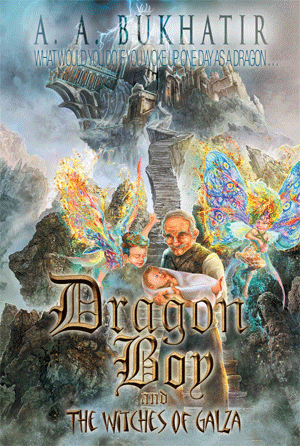
Dragon Boy and the Witches of Galza ($15.95, Xlibris, softcover) is a debut novel in a planned series by A.A. Bukhatir and it will appear to younger readers age 12 and up with its story of an old woodcutter named Aijou who mourns the death of his cherished wife, living in near total isolation. His life takes a dramatic change when, having lost his way in an enchanted forest, he encounters two tiny fairies engaged in a battle with a fire-breathing she-dragon. They prevail and as she lays dying she assumes her human form and begs Aijou to adopt her baby boy. He agrees, not know that the infant is actually a dragon. This is an intricate story filled with all the elements of fantasy and mystery that will intrigue younger readers. A non-scary story along the lines of Alice in Wonderland has been penned by Mark J. Grant. Lila: The Sign of the Elven Queen ($14.95, Mascot Books) is a modern fairy tale about s six-year-old girl who lives in New York. She has two cats, but dogs are not allowed in her apartment building, so she asks her parents if she can have an invisible dog.  They agree and as they go about buying invisible pet supplies for “Fluffy” when a black and white Aussie appears to Lila and introduces himself as Fluffy. All manner of adventures follow, including invisible people who discover a birthmark on Lila that is the sign of their Elven Queen. When she turns seven, she is made a princess. This is an instant modern fairy tale and one that is sure to please ages eight and older.

 
The best thing about Green Golly & her Golden Flute ($19.99, Eifrig Publishing) is the CD of music performed by Keith Torgan and Barbara Siesel, the authors of this book for those ages 4-10 that comes with it. Suzanne Langelier-Lebeda illustrated it, but even her artwork cannot rescue the story that is based on the tale of Rapunzel whose long hair helped her escape from the tower in which she had been put. Whether read to at bedtime or read by the child, the story that begins with the baby Golly’s parents giving her away to a witch for a bowl of salad is so inherently terrifying that everything that follows defies the understanding of the world by even the youngest reader. The intent was to spark an interest in classical music, but the result is a poorly conceived, poorly written story with negative themes throughout.
 
Novels, Novels, Novels

 
While I receive many books each month, the vast bulk of them continue to be novels and there is apparently no end to the hunger for a good story.


Judge Jeanine Pirro has made a name for herself as the host of a Fox News show. I don’t know where she finds the time to write novels, but she is also gaining recognition for her “Dani Fox” series based on a smart and sexy female assistant DA in Westchester County. Her second novel, as the first, draws heavily on her own experience in the field of law. In Clever Fox ($19.99, Hyperion) Dani has won a big case, but lost her true love, and now she must take on the case of a gruesome murder of a young woman with family ties to the New Jersey mafia. This pits her against a powerful New York crime boss, the press, and her boss. Fortunately she has an experienced detective on her side.  Not only is she a good story teller, but Pirro has an ear for the way those in law enforcement talk to one another and deal with the pressures involved. She also knows what it is like to have been young and inexperienced in a male dominated environment. This novel works on many levels. Crime and the suspense that goes with it have established John Rector as a leading novelist and bestselling author. His fans will welcome his return with Out of the Black ($14.95, Thomas & Mercer, softcover) in which Matt Caine, a Marine who has completed a harrowing tour of duty in Afghanistan is trying to put his life together after the death of his wife and the responsibility for his young daughter Anna. He is, however, jobless, broke, and in debt to a notorious loan shark. When a drug addict from his pre-Marine days slithers back into his life and offers him a job driving a van for a supposedly foolproof and profitable kidnapping job, Caine realizes too late that the target is the wife of a powerful crime boss. The tension just mounts from there and you will find yourself reading with rapt attention to see how events play out. When you hear the name John Gilstrap you know you’re in for a high suspense reading experience. He’s back in a paperback, High Treason, ($9.99, Kensington Publishing) featuring freelance hostage rescue specialist Jonathan Grave in a fifth installment of Gilstrap’s series. The First Lady has been kidnapped and the FBI director knows that Grave is a man who always gets results, no matter what, and this is a mission that must be carried out with utmost secrecy. In tracking his way through a labyrinth of lies and murder, Graves discovers a traitor at the highest level of Washington power who is about to commit the ultimate act of terror. It’s great reading at the beach or patio as summer comes to an end.

 
Another writer of renown is J.M. Coetzee, the author of 21 books that have been translated into many languages. He has twice been awarded the prestigious Booker Prize and in 2003 won the Nobel Prize in Literature. A native of South Africa, he now lives in Adelaide, Australia, and his latest book is curiously titled The Childhood of Jesus ($26.95, Viking) even though it is not about Jesus, but rather about a small boy who arrives by boat in a new country after having been separated from his parents and the piece of paper that would explain everything. During the trip, a man has taken it upon himself to look after him and upon arrival they are assigned new names, new birthdates, and essentially new lives. They know little Spanish, the language of the land in which they find themselves. The renamed Simon and David make their way to a relocation center and Simon finds a job on a grain wharf where he warms to his co-workers. He knows, however, he must locate David’s mother. While walking in the countryside with David he catches sight of a woman he is certain is the person for whom he is looking and persuades her to assume the role. There are many levels to this story of renewal against great odds and it is testimony to why Coetzee is regarded as one of the great authors of our time.
 
Ralph “Gaby” Wilson has beaten the odds of writing and selling screenplays many times, having sold 45 of them and now he has tried his hand as a novelist with Illegal Woman: A Gypsy Love Story ($19.99, Xlibris, softcover), about a young writer from Kansas who meets a gypsy woman in 1965 France. It is an unusual encounter as K.P. Kelly finds himself marooned in Europe without any money and alone. His only hope is to hitchhike to Paris where he there may be some checks from his publisher at an American Express office. He is 600 miles away when he catches the eye of an alluring Gypsy woman, Kalina, who teaches him how to travel by his wits. For a while he lives with her family and learns the Gypsy culture and together they travel across France in a spicy romp. This book is a lot of fun to read. Vermont could not be a more different locale, but it is the setting for You Knew Me When by Emily Liebert ($15.00, New American Library, softcover). Katherine Hill left her small New England hometown in pursuit of a dream and now, twelve years later, she is a high-powered cosmetics executive in Manhattan, far removed from her former life. By contrast, her former friend, Laney Marten, did not get to live out her dreams, becoming a young wife and mother. When Katherine receives word of an inheritance from a former neighbor, she reluctantly returns home where she is met by Laney and, tethered together by their shared inheritance of a sprawling Victorian mansion, they must address their long-standing grudges and determine if their earlier friendship can be revived. This is a novel that women will find of interest.
 
Some novels do not neatly fit into a particular genre. Several that explore the human condition provide some intriguing reading. From Canada, the award-winning author Jane Urguhart has written Sanctuary Line ($24.95, Quercus) about 40-year-old Liz Crane who returns to her family home on the shores of Lake Erie in southern Ontario with the intention of gathering data on the migration patterns of the monarch butterflies that leave Canada every winter for Mexico.  As she re-establishes herself in the place where she grew up, a commercial fruit orchard that is still productive but falling into disrepair, she finds her attention being overtaken by the powerful memories of childhood and the generations that came before her. Never married, she realizes that she leaves no one to carry on the family line. This is a novel of the mind and heart where a life is examined against the metaphor of the monarch butterflies and their migrations.
 
Between a Mother and Her Child by Elizabeth Noble ($15.00, Berkley, softcover) explores how a tragic death can tear apart the seemingly comfortable marriage of Maggie and Bill Barrett, and their three children. On December 26, 2004, their lives in London are shattered by news that their eldest son has been killed in a tsunami that left thousands dead. Maggie shuts down, unable to connect to her children or husband. Feeling isolated, Bill leaves to try to find some peace on his own and, when he announces he has fallen for another woman, Maggie finally realizes it’s time to move on and to pull her family back together. Her sister, on a visit, from Australia steps in to find a path to healing and it all adds up to a compelling story. Many baby boomers from the 50s and 60’s wake up to discover that the American dream they thought would be the pattern for their lives did not provide the answers they sought. Wallace Rogers debuts as a novel with Byron’s Lane ($15.99, London Street Press, softcover) He has been the mayor of Eau Claire, Wisconsin, and manages a consulting business involving local governments. It never fails to amaze me where talent is found. In this novel, narrated through the thoughtful witness of his friend Tom, we follow Jonathan Adams as he examines his life at late middle age. A civil contract in Iraq, he thought he could improve people’s lives through democracy, but finds himself traumatized by his experiences there, bitter about a failed relationship, and distressed by the feeling he has become irrelevant in the new century. Baby boomers in particular will find this novel of interest, but it is a good read for anyone. The quest for meaning in one’s life is also found in Derek Sherman’s Race Across the Sky ($16.00, Plume, softcover. It spans two very different, but equally fascinating worlds, the cult of ultra-marathoners and the underbelly of the biotech industry. It is a story of the lengths a family will go to save each other. Caleb Oberest is the ultra-marathoner who left behind his workaholic life in New York and severed all ties to his family and friends to run the 100-mile marathons across treacherous mountains. His brother, Shane, is a sales rep for a cutting-edge biotechnology firm, creating new cures for disease. Despite his efforts, there were distances between him on Caleb and Caleb has fallen in love with a new member of his marathon group and her infant daughter. When he discovers the baby has a fatal disease, he reaches out to Shane. Much is at stake for both brothers and you will be turning the pages as fast as you can to find out how the story concludes.
 
Machiavelli—A Renaissance Life by Joseph Markulin ($21.95, Prometheus Books, softcover) could only have been written by a former professor of Italian and Comparative literature with a specialty in Medieval and Renaissance studies. The result is history in a novel during the turbulent era of Florence’s Medici family, the nefarious Borgias, and artists Leonardo da Vinci and Michelangelo, and the doomed prophet Savonarola. Machiavelli is famed for his instructions on governance, The Prince, but this novel fleshes out his life as he does his best to navigate Florentine Renaissance politics. It is a riveting story and will also impart a grasp of history you will find intriguing. Historical fiction is also found in Robert the Bruce by Jack Whyte ($27.99, Forge Books), the second volume of his “The Guardians” series as he follows Scotland’s greatest heroes as they rise to glory and become legend. The first was devoted to William Wallace and this novel tells the story of a man who is remembered as a national hero and one of Scotland’s greatest kings. It is a hefty volume at 573 pages and will satisfy anyone who enjoys the fully-told story of the decades-long path of the struggle for Scottish freedom. In May 1328, King Edward III signed the Treaty of Edinburgh-Northampton that recognized Scotland as an independent kingdom and Bruce as its king.

 
The passing of the great novelist Elmore Leonard in August was a reminder of how blessed we are with the talents of superb storytellers. Leonard started out writing westerns and when that market lost its appeal he switched to writing the crime novels on which his reputation is based. My friend, James D. Best, seems to be making a similar journey because he is arguably one of the best writers of westerns, but his newest novel, The Return, ($12.95 Wheatmark, softcover) featuring Steve Dancy, a character from several of his previous novels, is set in the East. It is the summer of 1880 and Dancy has returned to New York from two years of misadventures in the West. Thomas Edison’s invention of the incandescent light bulb is about to put the gaslight industry out of business and Dancy sets out to obtain a license to sell electric lamps. Edison agrees on one condition; that he and his friends stop the saboteurs who are disrupting the electrification of Wall Street. That is just the beginning of Dancy’s newest set of challenges, along with the woman he has brought back with him and a feud that began out west and could cost him Edison’s backing. The action never stops until you get to the last page.
 
That’s it for September! So far the year has been filled with new non-fiction and fiction to satisfy any interest and there is still more to come as autumn ushers in many new books in anticipation of the Christmas season. Tell your book-living family, friends and co-workers about Bookviews.com where they will find news of these new books.